
NEWS
BREAKING: Iran attacks US 5th fleet in Bahrain after Trump launched ‘massive’ US and Israeli attack on Iran

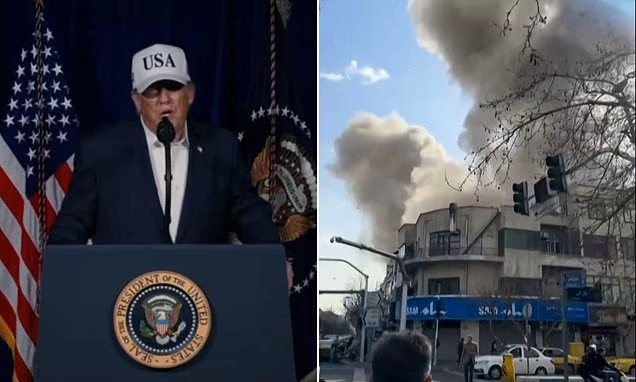
BREAKING: Iran Attacks United States Fifth Fleet in Bahrain After Donald Trump Launches “Massive” U.S.–Israeli Strike on Iran
Tensions in the Middle East exploded overnight after Iran launched a retaliatory strike targeting the United States Fifth Fleet headquarters in Bahrain, marking one of the most serious direct confrontations between Tehran and Washington in years.
The attack came just hours after President Donald Trump confirmed what he described as a “massive and decisive” joint military operation carried out by U.S. and Israeli forces against strategic targets inside Iran. According to early reports from regional officials, the U.S.–Israeli offensive focused on military infrastructure and facilities allegedly tied to Iran’s missile and nuclear programs.
Iran’s response was swift.
Shortly after the initial wave of strikes inside its territory, Iranian state media announced that its armed forces had launched missiles toward American military installations in the Persian Gulf. Explosions were reported near the U.S. Navy’s Fifth Fleet base in Bahrain — a critical command center overseeing naval operations across the Gulf, the Red Sea, and parts of the Indian Ocean.
Air-raid sirens reportedly sounded across parts of Bahrain’s capital, Manama, as defense systems attempted to intercept incoming projectiles. Residents described flashes in the night sky and loud blasts echoing across the coastal city. Bahraini authorities urged civilians to remain indoors while security forces assessed the situation.
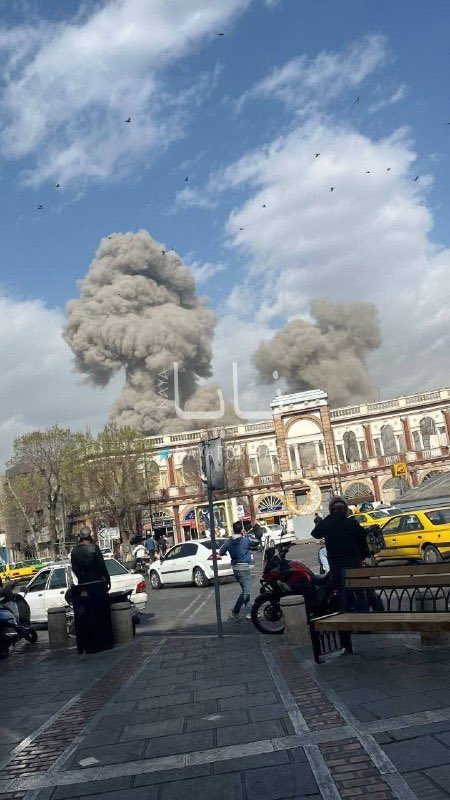
The Fifth Fleet is not just any base. It represents the backbone of U.S. naval power in one of the world’s most strategically sensitive waterways. From this headquarters, American forces monitor shipping routes and protect commercial vessels passing through the Strait of Hormuz — a narrow passage that carries a significant percentage of the world’s oil supply. Any disruption in that corridor has immediate global economic implications.
President Trump, in a statement following the U.S.–Israeli offensive, argued that the strikes were necessary to neutralize what he called an “imminent threat.” He claimed Iran had accelerated activities that posed direct risks to American allies and military personnel in the region. The White House framed the operation as preventative rather than provocative.
Tehran strongly rejected that characterization.
Iranian officials labeled the initial attack an act of aggression and vowed retaliation. Within hours, missiles were reportedly launched toward multiple U.S.-linked sites in the Gulf region, with the Fifth Fleet headquarters in Bahrain becoming the most symbolically significant target.
Military analysts say the decision to strike the Fifth Fleet signals a calculated message from Iran: if its territory is attacked, American assets across the region will not remain untouched. However, experts also caution that both sides may be attempting to demonstrate strength without crossing into full-scale war.
Regional governments moved quickly to secure their airspace. Several Gulf nations temporarily suspended flights, and emergency response teams were placed on high alert. Oil markets reacted nervously in early trading, reflecting investor fears that the conflict could threaten maritime shipping routes.
So far, there has been no confirmed report detailing the full extent of damage at the Fifth Fleet headquarters. U.S. defense officials have indicated that defensive systems were activated and that assessments are ongoing. Casualty figures, if any, have not yet been publicly released.
Israel has not publicly commented in detail on Iran’s retaliatory strike but reaffirmed its position that it will continue to act against threats originating from Tehran. The coordinated nature of the initial U.S.–Israeli operation suggests close strategic alignment between Washington and Jerusalem.
The larger concern now is escalation.
Direct military exchanges between Iran and U.S. forces carry risks that extend far beyond the Gulf. Proxy groups aligned with Tehran operate in several neighboring countries, and previous confrontations have sometimes expanded through indirect channels. Diplomatic backchannels are reportedly active as global powers urge restraint from both sides.
International leaders have begun calling for immediate de-escalation, warning that prolonged hostilities could destabilize the entire region. The Gulf is home to critical energy infrastructure, multinational corporations, and tens of thousands of foreign nationals — all potentially vulnerable if the situation intensifies.
For now, the world watches closely.
The strike on the United States Fifth Fleet in Bahrain represents more than retaliation; it signals a dangerous new phase in U.S.–Iran tensions. Whether this moment becomes a contained exchange of force or the opening chapter of a broader conflict will likely depend on decisions made in Washington, Tehran, and Jerusalem in the coming hours and days.
This is a developing story, and updates are expected as official confirmations emerge.

BREAKING: Kylie Kelce Has Been Confirmed to Be… Following Tiger Woods’ Rollover Car Crash

Did Travis Kelce Really Say “I’m Breaking Up With You” During Taylor Swift’s Shout-Out to Him at the iHeartRadio Music Awards?… See More

Watch Taylor Swift Blush and Give the Cutest Response When Asked About Travis Kelce at the iHeartRadio Music Awards 2026

Taylor Swift makes a stunning picture-perfect appearance at the 2026 iHeartRadio Music Awards, but fans can’t stop talking about one detail in her look… See more photos details

Travis Kelce spotted looking very angry arriving at the 2026 iHeartRadio Music Awards in new video — not only because Taylor Swift refuses to walk with him, but because… See more details and clear clip

BREAKING: Kylie Kelce Under Fire After Washing Wyatt’s Mouth With Soap for Cursing – Wyatt Has Been Confirmed… See More

Emotional Video of Travis Kelce Crying Multiple Times During His Tuxedo Fitting for the Big Day Breaks the Internet

Taylor Swift Abruptly Crashes Her Fiancé Travis Kelce’s Signing for a Three-Year, $54.7M Deal, Saying She’s Tired of the Wait and Demanding He Choose Between Her and His Career, and the Chiefs Star Shockingly Chooses… See More

BREAKING: Jason Kelce Breaks Down in Tears After Shocking LaGuardia Plane Crash His Wife Kylie Kelce Has Been Confirmed to Be… See More

BREAKING: Traumatized Donna Kelce just revealed her son Jason and his wife Kylie Kelce has been confirmed… See more

JUST IN: Kylie Kelce, Age 33, Wife of Jason Kelce, Has Been Confirmed to Be… See More
