
NEWS
Iran’s Supreme Leader is dead, Trump announces: President shown a picture of Ayatollah Ali Khamenei’s body after he was killed in airstrike on compound

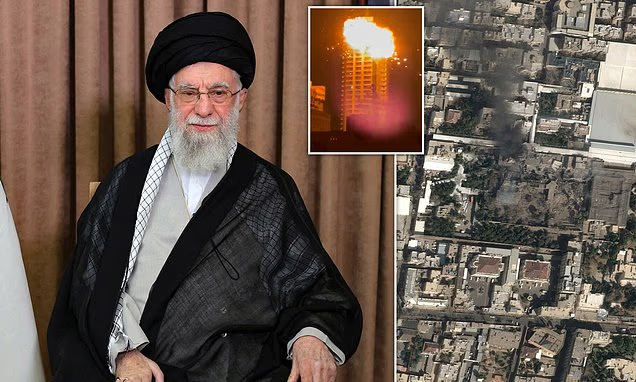
Iran’s Supreme Leader, Ali Khamenei, has reportedly been killed in a massive airstrike on his compound, according to an explosive announcement by U.S. President Donald Trump — a claim that, if confirmed, would mark one of the most dramatic turning points in modern Middle Eastern history.
Speaking to reporters following what officials described as a coordinated U.S.-Israeli military operation, Trump stated that he had been shown a photograph of Khamenei’s body after the strike. The image, he said, was presented as confirmation that the long-time Iranian leader had been eliminated during the targeted bombing of a heavily fortified compound in Tehran.
The airstrike reportedly took place under the cover of darkness, with precision-guided munitions striking key strategic locations believed to house senior Iranian leadership. Military officials described the compound as one of the most secure sites in the country — reinforced, guarded, and deeply embedded within Iran’s command structure. Yet the operation appears to have pierced through those defenses with devastating force.
Khamenei, who had ruled as Iran’s supreme leader since 1989, was the most powerful figure in the Islamic Republic. As the ultimate authority over the military, judiciary, and major state decisions, his influence extended far beyond Iran’s borders. For decades, he shaped Iran’s posture toward the United States, Israel, and regional conflicts across the Middle East. His reported death instantly throws that entire structure into uncertainty.
President Trump described the moment he was shown the photograph as “confirmation of a decisive strike,” adding that intelligence sources had high confidence in the identification. He did not provide additional details about how the body was verified, nor did he specify who conducted the confirmation process. However, he characterized the strike as a “turning point” in what he called a necessary action to neutralize escalating threats.
The announcement sent shockwaves through global capitals within minutes. Markets reacted sharply. Oil prices spiked on fears of retaliation and potential disruption to critical shipping routes in the Persian Gulf. Military bases across the region reportedly heightened their alert levels as analysts warned that Iran’s response — if and when it comes — could be swift and severe.
In Tehran, official channels initially remained silent. Iranian state media did not immediately confirm the claim, instead referring to “enemy psychological warfare.” The absence of clear confirmation from Iranian authorities has fueled both skepticism and intense speculation. In a nation where information is tightly controlled, clarity may not come quickly.
The potential implications are enormous. Iran’s system of governance depends heavily on the authority of the supreme leader. While there is a constitutional process for succession through the Assembly of Experts, the sudden removal of such a central figure during an active military confrontation could trigger internal instability. Power struggles behind closed doors are now considered highly likely, according to regional observers.
Beyond Iran’s borders, the stakes are equally high. Iran has long supported allied groups across the Middle East, and those networks could interpret the strike as an act of war demanding retaliation. Israel and U.S. military assets in the region may face increased threats. The possibility of escalation into a broader regional conflict now looms heavily.
Supporters of the operation argue that eliminating Iran’s top decision-maker cripples its strategic command and weakens its capacity to coordinate attacks. Critics warn that removing a central authority figure without a clear diplomatic pathway could create chaos, miscalculation, and prolonged instability.
For ordinary Iranians, the uncertainty may be the most frightening element of all. Years of economic sanctions, internal protests, and political pressure have already strained the population. A sudden leadership vacuum amid external military strikes adds another layer of unpredictability to daily life.
International leaders have begun urging restraint. Calls for de-escalation and emergency diplomatic engagement are growing louder, as governments weigh how to prevent the situation from spiraling further. The United Nations is expected to convene urgent discussions, while intelligence agencies worldwide scramble to verify facts and assess the authenticity of the claims.
At this moment, one fact dominates the global conversation: if the death of Ali Khamenei is officially confirmed, it will represent the end of an era in Iran and a seismic shift in Middle Eastern geopolitics. If the claim proves premature or inaccurate, it could still reshape diplomatic and military dynamics due to the mere assertion itself.
The world now waits — for confirmation, for retaliation, or for diplomacy to intervene before events move beyond control.

BREAKING: Kylie Kelce Has Been Confirmed to Be… Following Tiger Woods’ Rollover Car Crash

Did Travis Kelce Really Say “I’m Breaking Up With You” During Taylor Swift’s Shout-Out to Him at the iHeartRadio Music Awards?… See More

Watch Taylor Swift Blush and Give the Cutest Response When Asked About Travis Kelce at the iHeartRadio Music Awards 2026

Taylor Swift makes a stunning picture-perfect appearance at the 2026 iHeartRadio Music Awards, but fans can’t stop talking about one detail in her look… See more photos details

Travis Kelce spotted looking very angry arriving at the 2026 iHeartRadio Music Awards in new video — not only because Taylor Swift refuses to walk with him, but because… See more details and clear clip

BREAKING: Kylie Kelce Under Fire After Washing Wyatt’s Mouth With Soap for Cursing – Wyatt Has Been Confirmed… See More

Emotional Video of Travis Kelce Crying Multiple Times During His Tuxedo Fitting for the Big Day Breaks the Internet

Taylor Swift Abruptly Crashes Her Fiancé Travis Kelce’s Signing for a Three-Year, $54.7M Deal, Saying She’s Tired of the Wait and Demanding He Choose Between Her and His Career, and the Chiefs Star Shockingly Chooses… See More

BREAKING: Jason Kelce Breaks Down in Tears After Shocking LaGuardia Plane Crash His Wife Kylie Kelce Has Been Confirmed to Be… See More

BREAKING: Traumatized Donna Kelce just revealed her son Jason and his wife Kylie Kelce has been confirmed… See more

JUST IN: Kylie Kelce, Age 33, Wife of Jason Kelce, Has Been Confirmed to Be… See More
